Driven by global carbon neutrality goals and the wave of energy transition, the photovoltaic industry is evolving from a single technological path toward a thriving and diverse ecosystem. A technological contest that will shape the future energy landscape has quietly begun.

Amid this green energy revolution, crystalline silicon technology maintains its mainstream status with its solid foundation, while cadmium telluride thin-film technology has emerged as a dark horse, carving out a new race track.
01 Technological DNA: Divergent "Origins"
The photovoltaic field is now evolving along diverse development pathways. From first-generation monocrystalline and polycrystalline silicon, to second-generation thin-film technologies like cadmium telluride and copper indium gallium selenide, and further to third-generation perovskite and organic solar cells, various technological routes are blossoming in a vibrant competition.
1. Crystalline Silicon: The Classic Art of "Subtraction" and "Assembly"
Rooted in the concept of "bulk semiconductors," each silicon cell is crafted through cutting and polishing high-purity silicon ingots. Electricity generation relies on the entire thickness of the silicon wafer, involving a lengthy process chain—a true marvel of precision industrial "assembly."
2. Cadmium Telluride: The Innovative Philosophy of "Addition" and "Growth"
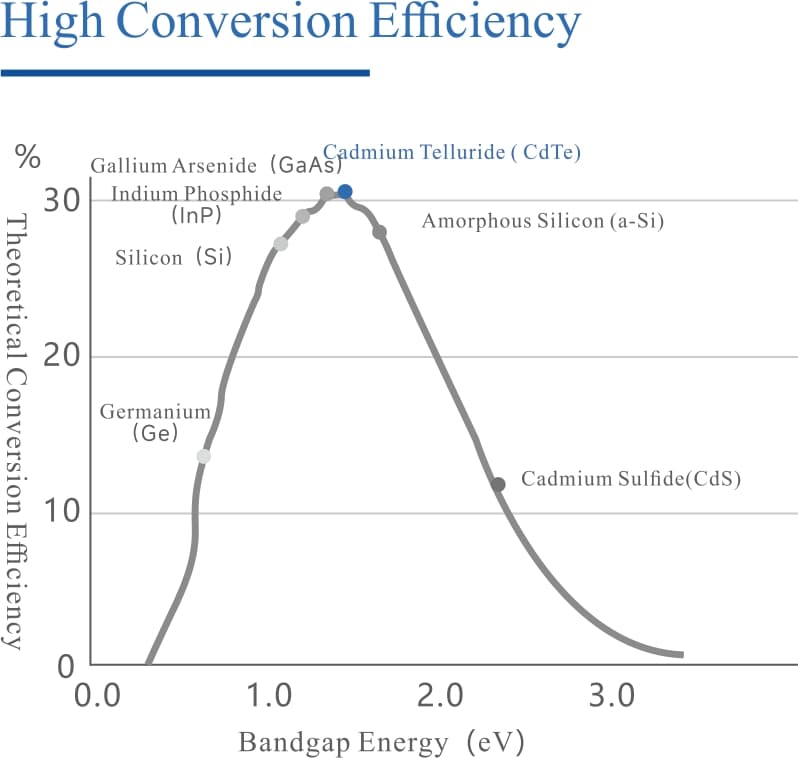
It grows a film merely a few micrometers thick directly on a glass substrate through techniques like vapor transport deposition. With a bandgap of 1.45 eV, it aligns almost perfectly with the solar spectrum, exhibiting an intrinsic potential for highly efficient photon conversion.
This fundamental difference in technological DNA dictates distinctions in their performance, application scenarios, and future development paths.
02 Power Generation Performance: Lab Efficiency vs. Real-World Output
In the photovoltaic field, there is often a gap between laboratory data and real-world performance. The advantage of cadmium telluride lies precisely in its exceptional real-world performance.
1. Superior Performance in Low-Light Conditions
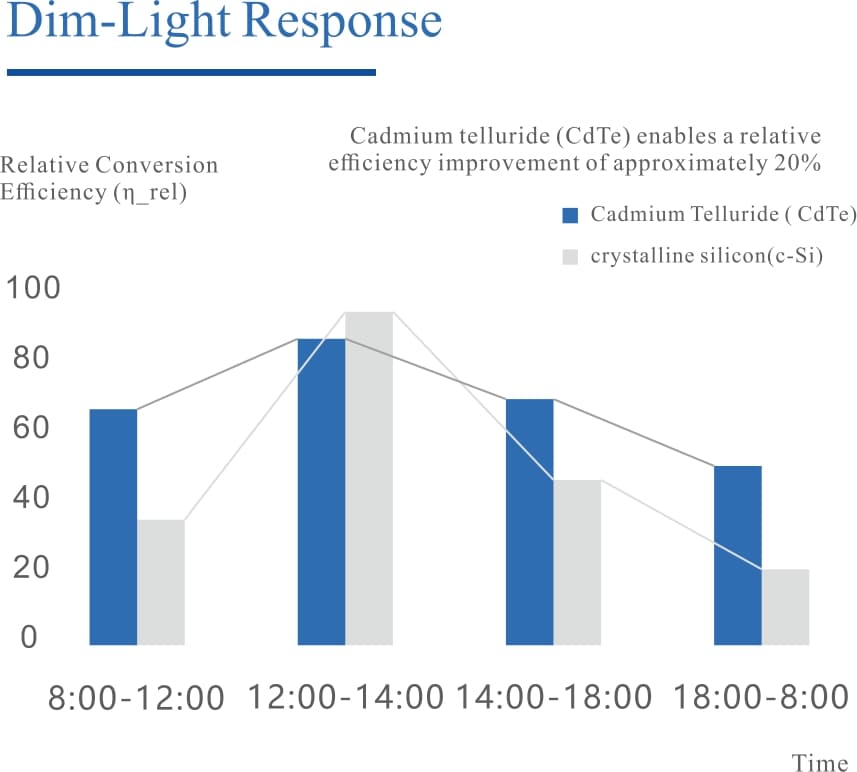
Cadmium telluride is not picky about light angles. Whether on cloudy days, during dawn or dusk, or in complex environments with diffuse light reflection, it efficiently captures photons. This gives cadmium telluride a 10%-15% advantage in low-light response performance over traditional photovoltaics, resulting in 8%-17% higher power generation than crystalline silicon products under the same installed capacity.

2. High Temperature Tolerance, Steady as a Rock
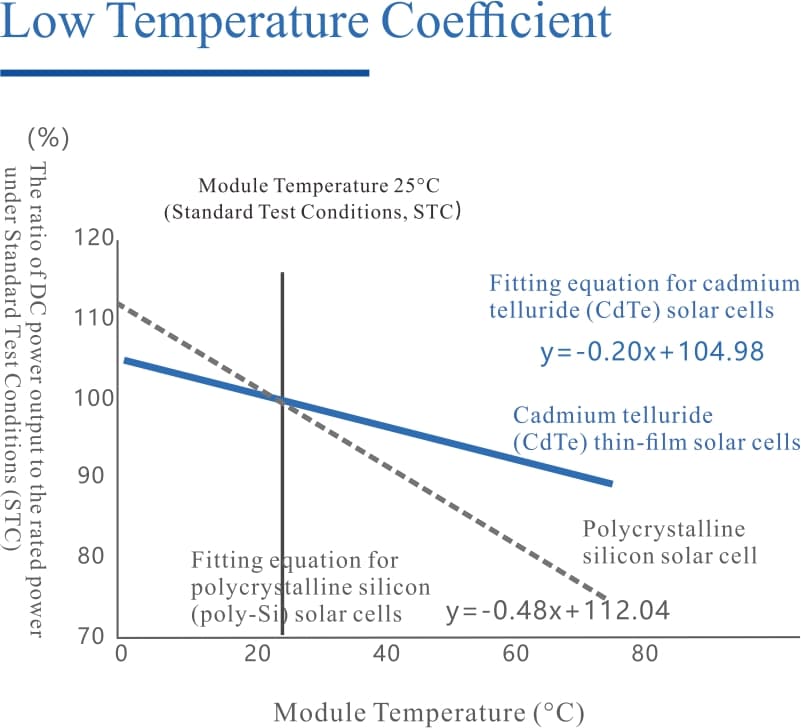
High Heat Tolerance, Steady as a Rock
Crystalline silicon modules are heat-sensitive—for every 1°C temperature increase, they suffer over 0.3% power loss. During hot summers, when module surface temperatures can easily reach 60-70°C, power generation declines significantly. In contrast, cadmium telluride boasts a superior temperature coefficient (approximately -0.21%/°C), maintaining more stable output in high-temperature regions and directly translating this technical advantage into more substantial power generation gains.
03 Application Scenarios: From "Showdown" to "Collaboration"
Each product has its unique strengths and ideal application scenarios. The relationship between crystalline silicon and cadmium telluride is gradually evolving from competition to complementarity.
Crystalline Silicon's Domain: Large-Scale Power Plants
With its mature supply chain and extreme cost-control capabilities, crystalline silicon dominates ground-mounted power stations and conventional rooftop projects. These large-scale, long-term operations align perfectly with crystalline silicon's strengths.
Cadmium Telluride's Blue Ocean: BIPV (Building Integrated Photovoltaics)
Here, cadmium telluride transforms into "power-generating building materials." It can be customized in size, transparency, and color, seamlessly integrating into architectural structures like glass curtain walls, industrial rooftops, and sunrooms. As building materials, these power-generating glasses offer excellent fire resistance and thermal insulation; as photovoltaic products, they feature high conversion efficiency ceilings, strong real-world power generation performance, minimal energy degradation, and enhanced safety.
Agrivoltaics: A Visionary Application
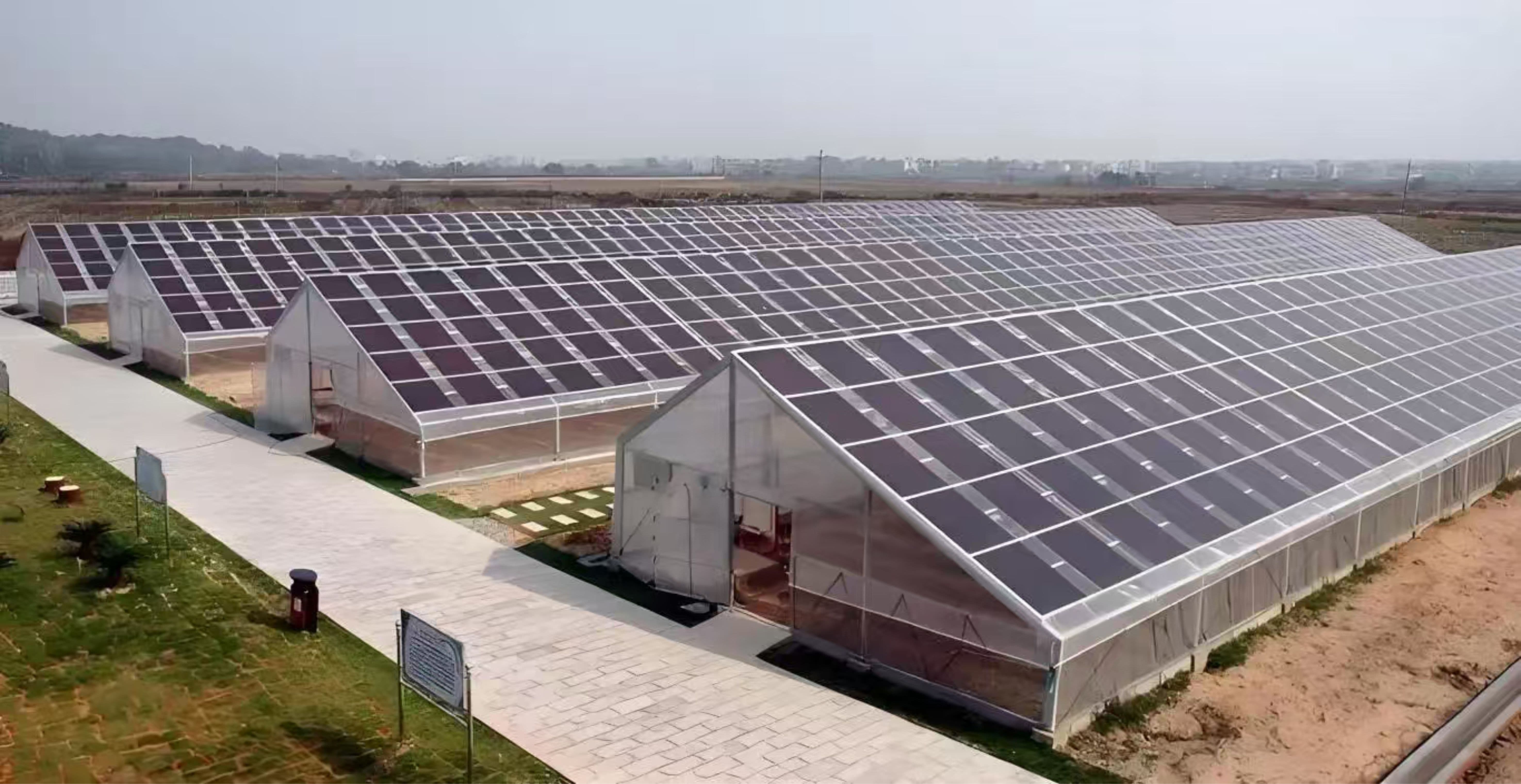
Using cadmium telluride modules with specific light transmittance levels (e.g., 20%, 40%) can provide uniform lighting for crops below. Compared to the patchy shadows cast by crystalline silicon, this approach is more conducive to plant growth, achieving a win-win scenario for "photovoltaics + agriculture."
04 Safety and Environmental Impact: Dispelling Misconceptions with Science
Safety: The Eliminator of "Hot Spot" Risks
Crystalline silicon modules are particularly vulnerable to partial shading—when blocked, the affected cells can shift from being "power generators" to "power consumers," leading to high-temperature "hot spots" that not only damage the modules but may even cause fires. Thanks to their unique elongated sub-cell design and high-voltage, low-current circuit characteristics, cadmium telluride modules structurally avoid such risks. Even when partially shaded, they do not experience significant temperature rises, fundamentally preventing overheating issues.
Environmental Impact: The Misunderstood Stable Compound
The public often reacts with concern at the mention of "cadmium." However, cadmium telluride boasts exceptionally stable chemical bonds (with a bond energy as high as 5.7 eV), making it one of the most stable forms of cadmium in nature. It is insoluble in water and weak acids, remaining safe and harmless during normal use. Over its entire lifecycle, its heavy metal emissions are even far lower than those of fossil fuels like coal and oil, comparable to natural gas.
05 Market Outlook: Coexistence and Prosperity, Advancing Toward a Green Future
Looking ahead, the global photovoltaic market continues to offer boundless opportunities. The competition and collaboration between crystalline silicon and cadmium telluride will jointly drive the industry toward greater efficiency, affordability, and sustainability in a shared journey toward a greener future.
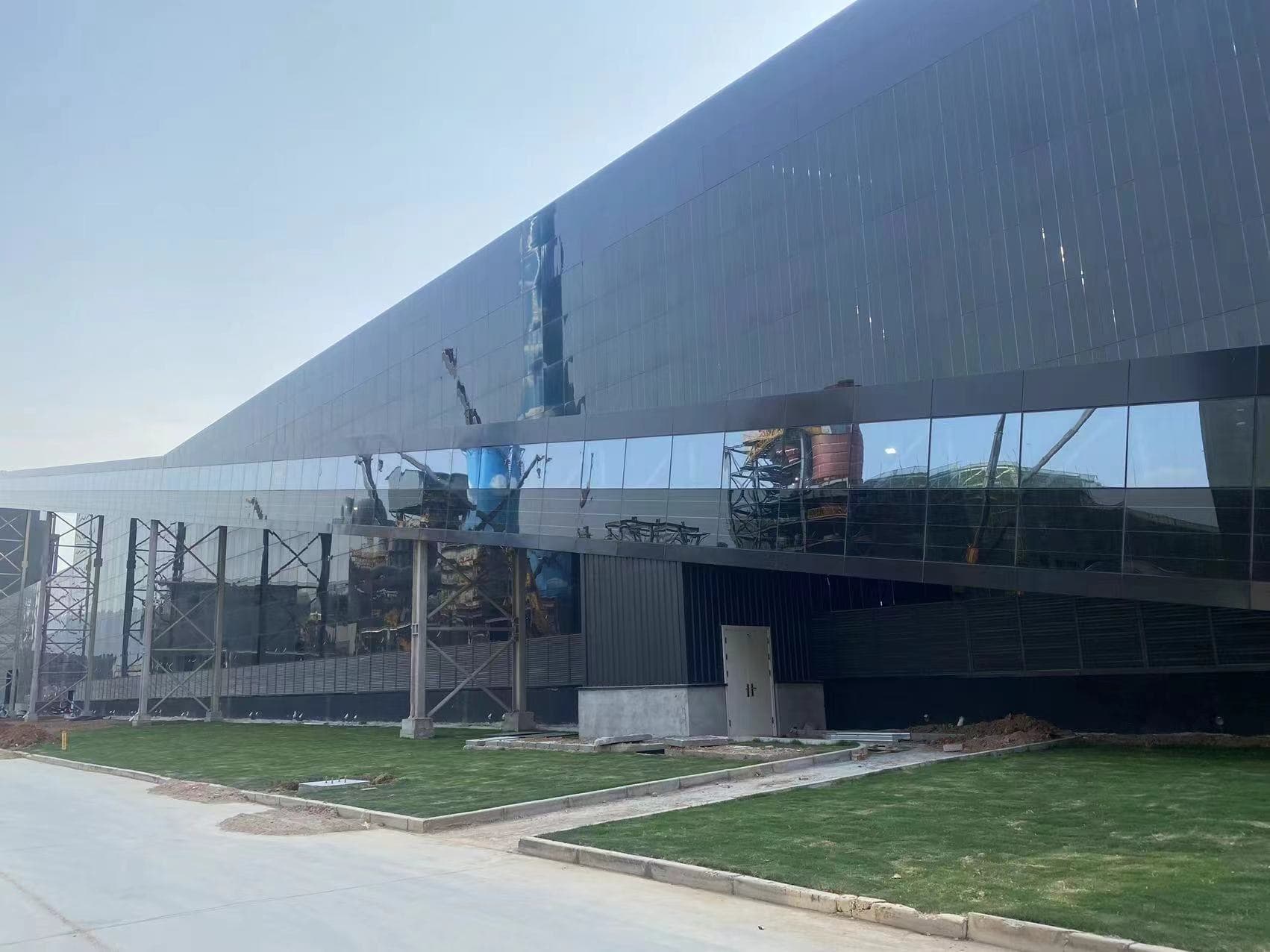
With the rapid rise of the BIPV market and the continuous expansion of differentiated application scenarios, Zmol New Energy Technology has made significant progress in the field of cadmium telluride power-generating glass, using the most suitable technological solutions to meet diverse energy needs. In the "next phase" of photovoltaics, cadmium telluride is poised to evolve beyond being just an "emerging competitor" and stand alongside crystalline silicon as another fundamental pillar supporting a zero-carbon future.