Zhu Kai's team at the National Renewable Energy Laboratory (NREL) published a research paper titled "C60-based ionic salt electron shuttle for high-performance inverted perovskite solar modules" in the journal Science. Shuai You from the NREL is the first author of the paper, and Marina Freitag from Newcastle University, UK, Yanfa Yan from the University of Toledo, Osman M. Bakr from King Abdullah University of Science and Technology, and Zhu Kai from the NREL are the co-corresponding authors of the paper.
Key Highlights:
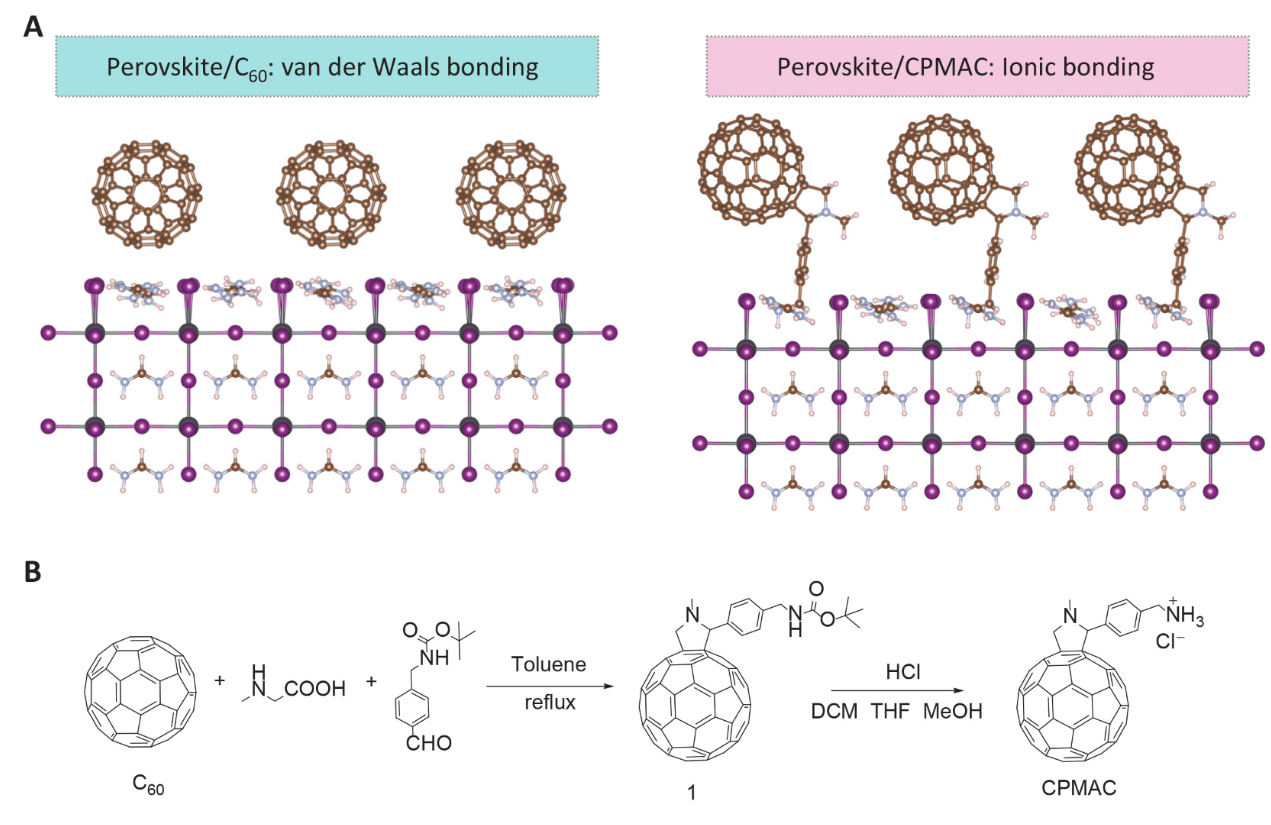
Innovative Material Design: By synthesizing a C60-derived ionic salt, CPMAC, the interfacial bonding and mechanical stability of the electron transport layer were significantly enhanced, addressing the weak interface issues of conventional C60 molecular layers.
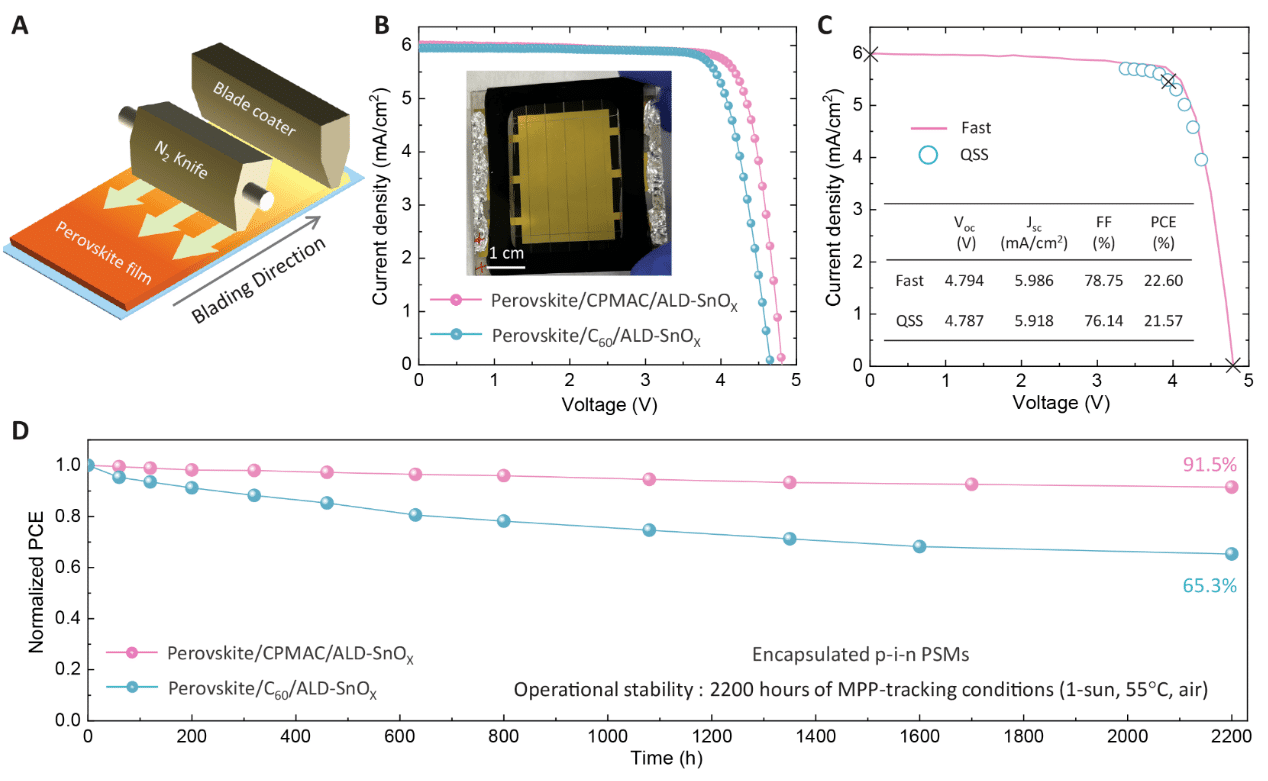
High Efficiency and Stability: CPMAC-based solar cells achieved a high efficiency of 26% and exhibited extremely low performance degradation (only 2% degradation after 2100 hours) under high-temperature and long-term operation, demonstrating excellent commercial potential.
Scaled Application Verification: CPMAC also demonstrated excellent performance (PCE 23%) and stability (<9% degradation after 2200 hours) in small-scale modules, paving the way for the industrialization of perovskite solar technology.
Inverted p-i-n type perovskite solar cells (PSCs) have shown promising commercialization potential due to their simple fabrication process, low-temperature processability, and compatibility with tandem cells. However, large-scale device fabrication and long-term operational stability remain key bottlenecks for commercialization. Although C60 is commonly used as an electron transport layer (ETL) in inverted perovskite solar cells (PSCs), its molecular properties lead to weak interfacial bonding, which can easily lead to non-ideal interfacial electronic and mechanical degradation.
To address this issue, Marina Freitag of Newcastle University, UK; Yanfa Yan of the University of Toledo; Osman M. Bakr of King Abdullah University of Science and Technology; and Kai Zhu of the National Renewable Energy Laboratory in the United States synthesized a C60-derived ionic salt, 4-(1',5'-dihydro-1'-methyl-2'H-[5,6]fullerene-C60-In-[1,9-c]pyrrol-2'-yl)benzylamine chloride (CPMAC), and used it as an ETL in inverted PSCs. The CH2-NH3+ headgroup in CPMAC improves the ETL interface, and its ionic properties enhance the packing density, resulting in an approximately threefold increase in interfacial toughness.
Devices using CPMAC achieved a power conversion efficiency (PCE) of approximately 26% and only degraded by approximately 2% after 2100 hours of operation at 65°C under 1-sun illumination. For small modules (four subcells, 6 cm²), the PCE reached approximately 23%, with degradation less than 9% after 2200 hours of operation at 55°C.
This study demonstrates that the ionic salt CPMAC can effectively address the mechanical instability of molecular C60 in inverted perovskite solar cells (PSCs). Compared to C60, the ionic properties of CPMAC significantly strengthen the ETL/perovskite interface, allowing efficient device operation with only an ultrathin CPMAC layer. The application of CPMAC not only improves device efficiency but also significantly enhances operational stability. This study further validates the applicability of CPMAC in the development of micromodules, achieving modular efficiency and operational stability that are among the best reported in the literature. This provides a promising solution for the commercialization of perovskite photovoltaic technology.