Alex K.-Y. Jen's team at City University of Hong Kong published a research paper titled "Molecularly tailorable metal oxide clusters ensure robust interfacial connection in inverted perovskite solar cells" in Science Advances. Li Fengzhu is the first author, and Alex K.-Y. Jen and Yin Jun are co-corresponding authors.
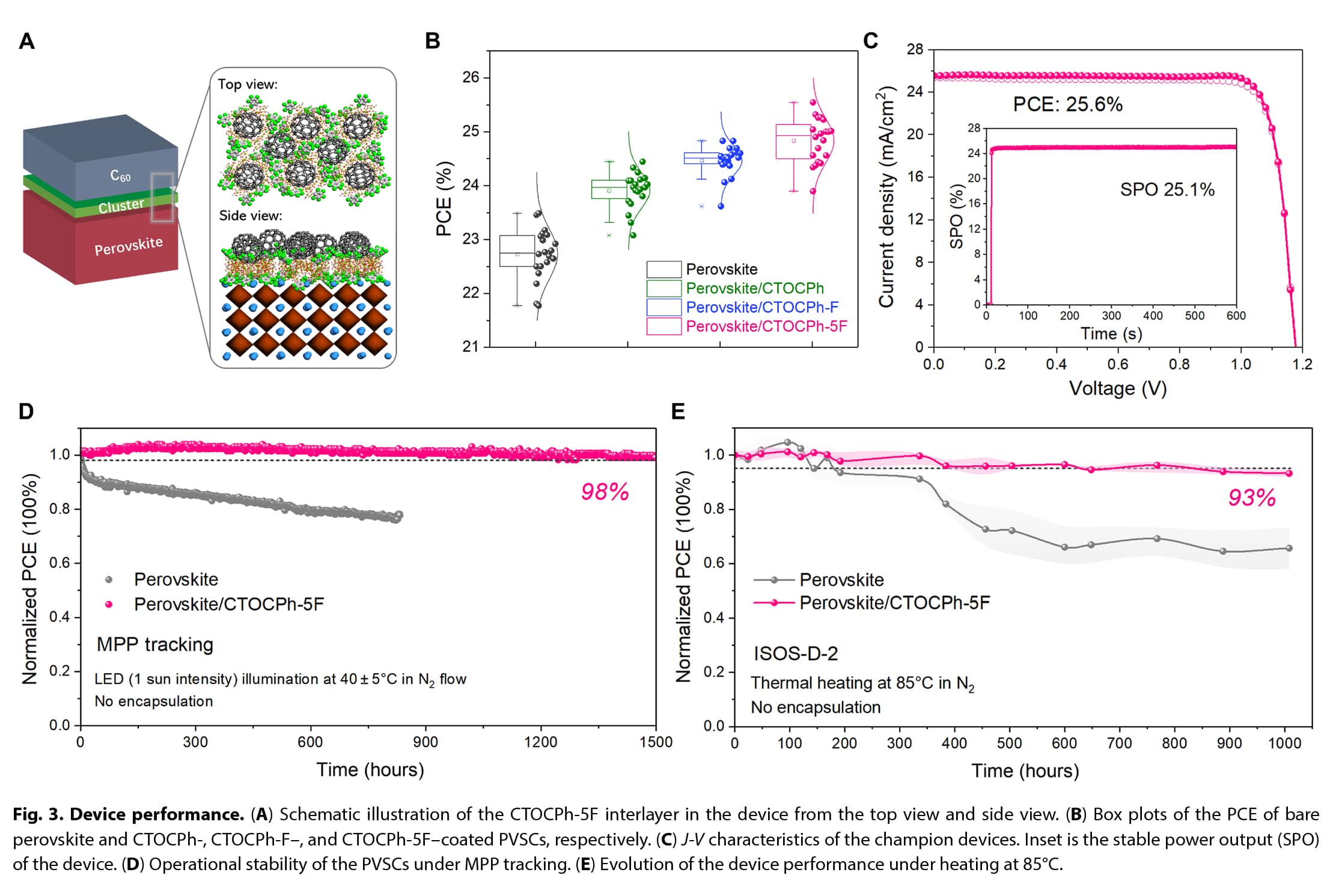
Key Highlights: This paper designs a series of molecularly tailorable clusters as interlayers that simultaneously enhance the interaction with C60 and perovskite. The targeted inverted PVSCs achieve a power conversion efficiency (PCE) of 25.6% without additional surface passivation. Notably, the unencapsulated devices exhibit excellent stability under light, heat, and bias conditions, maintaining their initial PCE at 98% after 1500 hours of maximum power point (MPP) tracking and 93% after 1000 hours of heating at 85°C.
Interfacial recombination and ion migration between perovskite and electron-transporting materials remain persistent challenges in improving the efficiency and stability of perovskite solar cells (PVSCs). Extensive research has focused on interface modification, such as using large organic cations to form low-dimensional perovskite layers, aiming to reduce interfacial recombination losses and achieve ultra-low voltage deficit. However, electronic blockage and stability issues associated with organic cation migration at the two-/three-dimensional (2D/3D) perovskite interface have recently been highlighted. The movement of these ions, particularly under thermal and photostress, severely impacts the long-term stability of PVSCs for practical applications. Therefore, it is necessary to develop strategies to construct a sharp and robust interlayer to block ion migration and improve interfacial connectivity.
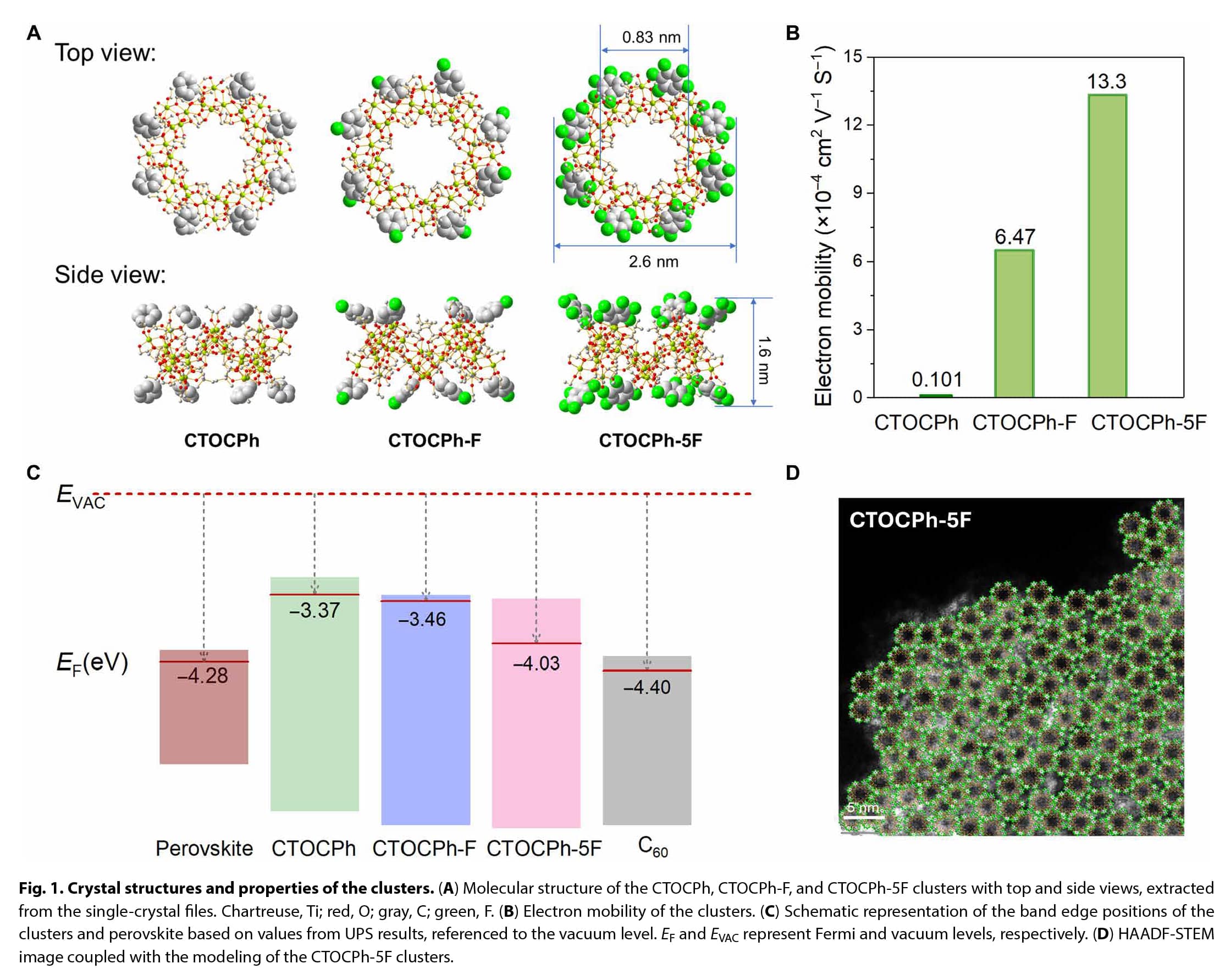
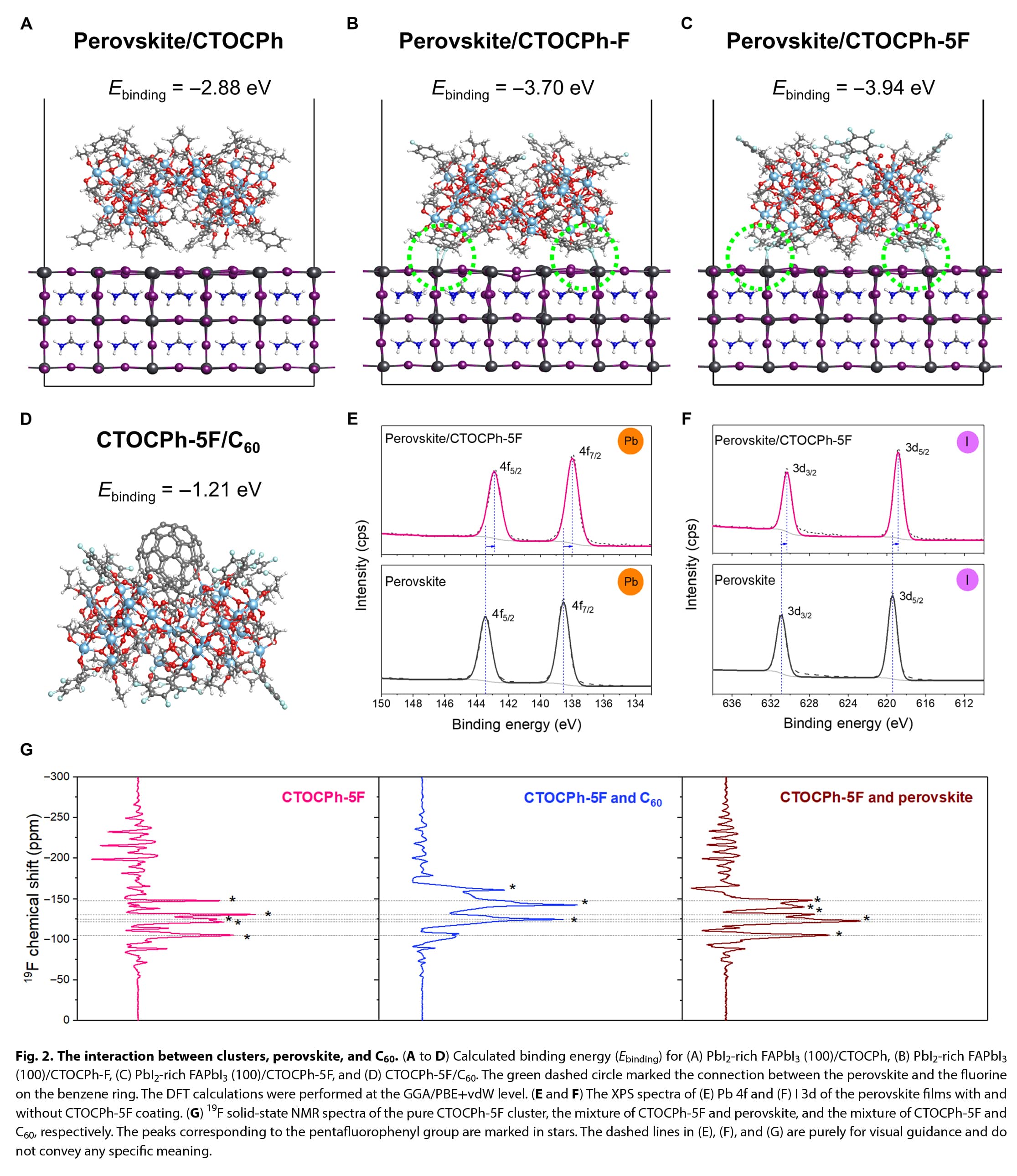
To this end, the team of Alex K.-Y. Jen and Jun Yin from City University of Hong Kong designed and synthesized a series of nano-sized cyclic titanium oxide clusters (CTOCs) with various fluoroaryl groups that can simultaneously enhance interactions with C60 and perovskite. These clusters possess precisely controlled structures, good carrier mobility, considerable solubility, suitable energy levels, and functional ligands, which can help passivate perovskite surface defects, form a uniform capping network to immobilize C60, and establish a strong coupling between perovskite and C60. The targeted inverted PVSCs achieved a power conversion efficiency (PCE) of 25.6% without additional surface passivation. Notably, the unencapsulated device exhibited excellent stability under light, heat, and bias conditions, maintaining its initial PCE at 98% after 1500 hours of maximum power point tracking and 93% after 1000 hours of heating at 85°C.
This study proposes an interfacial bridging strategy that simultaneously enhances the interaction with C60 and perovskite by incorporating customizable clusters of molecules with varying fluorine substitutions. The clusters' excellent intramolecular planarity and good solubility enable the formation of a dense and uniform capping layer without aggregation. This overcomes the challenges of persistent recombination losses and device degradation associated with the perovskite/ETL interface, paving the way for further development of advanced interface materials to improve the performance and durability of perovskite photovoltaic cells.

Source:
https://doi.org/10.1126/sciadv.adq1150