Amidst the global energy transition and
growing environmental awareness, green energy has become an integral part of
our lives. Photovoltaic curtain walls, a type of green building that converts
solar energy into electricity, are developing at an unprecedented rate. With
its high photoelectric conversion rate, excellent transmittance, and wide range
of applications, CdTe solar-generating glass presents a promising market
prospect in the field of building-integrated photovoltaics (BIPV).

How to choose the right CdTe
solar-generating glass product and its transmittance directly impacts its power
generation efficiency and practical application. Let's take a look at CdTe
solar-generating glass products from Zoom Solar Green Energy Technology as an
example.

1 Basic Principles and Characteristics of
CdTe Solar-generating Glass
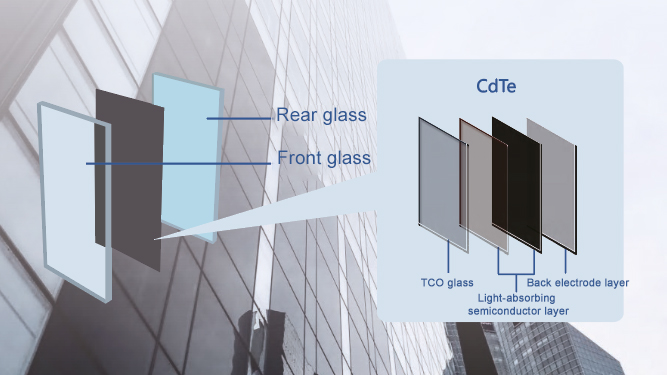
CdTe solar-generating glass is made by
dissolving cadmium telluride and cadmium sulfide at high temperatures into the
glass surface, then cutting it into cell modules using nano-lasers. Cadmium
telluride (CdTe) thin films are deposited on a glass substrate to form a
photovoltaic layer. When sunlight strikes the CdTe film, photons are absorbed
and excited to release electrons, generating an electric current and achieving
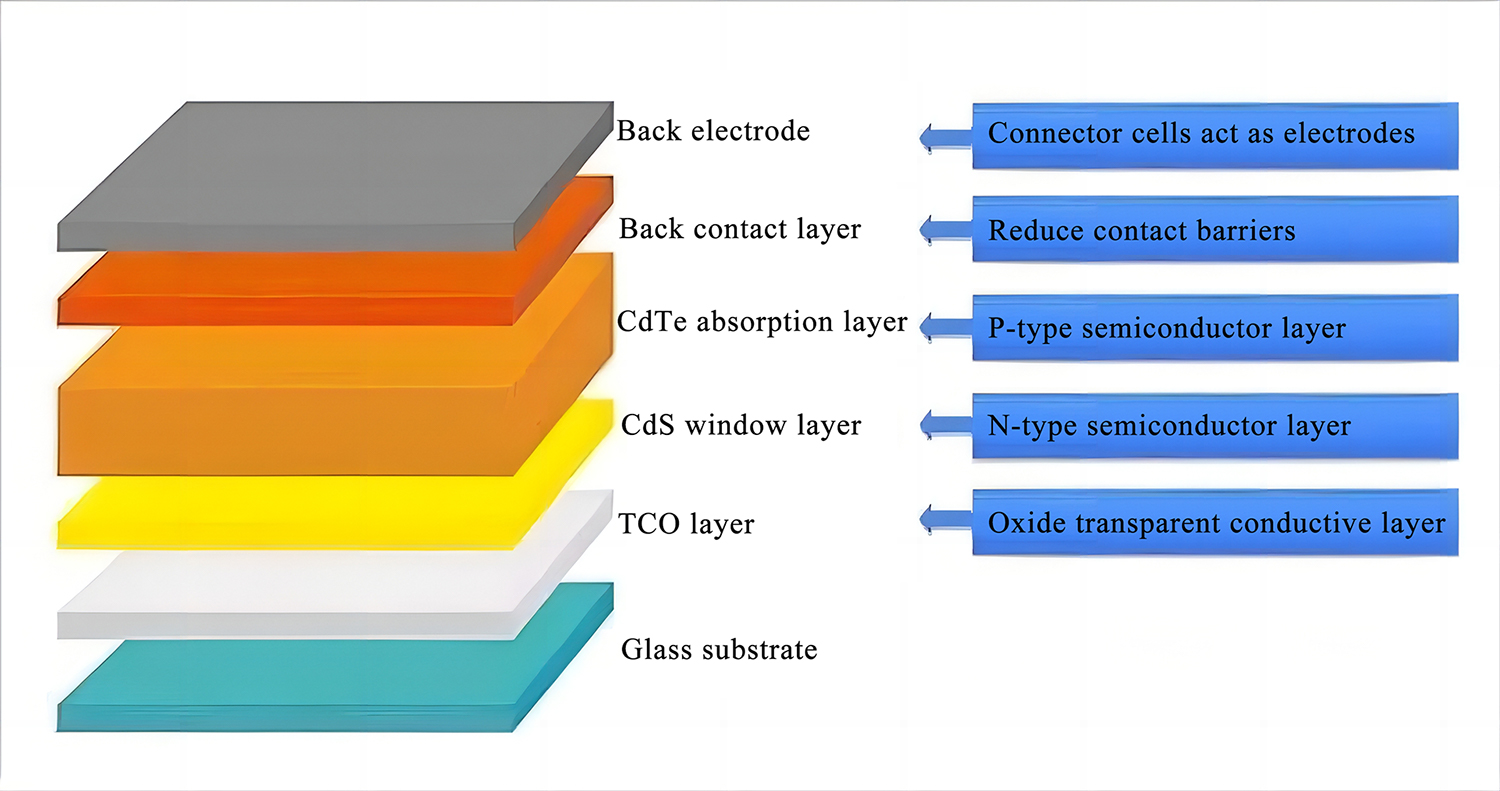
photoelectric conversion. Its core structure is relatively simple, consisting
of five layers: a glass substrate, a transparent conductive oxide (TCO) layer,
a cadmium sulfide (CdS) window layer, a cadmium telluride (CdTe) absorber
layer, a back contact layer, and a back electrode.
Currently, CdTe-based solar glass has the
highest market share in thin-film photovoltaic modules, accounting for over 95%
of all thin-film modules. Its advantages can be summarized as follows:
1. Cadmium telluride has a bandgap of 1.45
eV, making it the best solar cell absorber material for the terrestrial solar
spectrum.
2. Excellent low-light performance: Because
Cadmium telluride is a direct-gap material, it absorbs well across the entire
spectrum. Therefore, its performance in low-light conditions, such as early
morning, evening, and on rainy and snowy days, is significantly superior to
that of crystalline silicon cells made of indirect bandgap materials, reaching
100 times that of silicon.
3. Low temperature coefficient: The
temperature coefficient of the Cadmium telluride solar cell produced by Zoom Solar
Green Energy Technology is approximately -0.19%/°C, compared to -0.45%/°C for
crystalline silicon cells. This means that in high-temperature and
high-humidity environments, Cadmium telluride solar cell loses less power and
offers significant advantages in power generation performance.

4. Minimal hot spot effect: In partial
shade, the vertical scribe line design of Cadmium telluride cells minimizes
power loss, significantly improving power generation capacity, ensuring product
life, and ensuring safety.
5. Uniform Color, Elegant Appearance: Zoom
Solar Green Energy Technology's standard CdTe solar glass modules measure 1200
x 1600 mm. These products offer uniform color, a beautiful appearance, and a
strong overall appearance, making them particularly suitable for buildings
requiring high aesthetic standards.
6. High Power Generation Efficiency: With a
photoelectric conversion efficiency of 17%, these modules significantly
outperform crystalline silicon cells made of indirect bandgap materials in
low-light conditions such as early morning and evening. They also offer a long
operating life, generating approximately 3-8% more power than traditional
products of the same installed capacity.

7. High Degree of Customization: Color,
pattern, shape, size, and transmittance can be flexibly customized to meet
specific needs, making them a perfect alternative to traditional building
materials.
2. CdTe Solar Glass Product Transmittance
Options
Transmittance is a key indicator of the
visible light transmittance of CdTe solar glass. During production and
processing, different de-filming techniques are used to achieve varying
transmittances. Three common de-filming techniques are chemical de-filming,
physical de-filming, and laser de-filming. Zoom Solar Green Energy Technology's
CdTe solar glass uses laser de-filming technology to ensure that the de-filming
effect and glass quality meet user requirements.

In practical applications, the light
transmittance of CdTe solar glass not only affects daylighting but also
directly impacts the glass's power generation output and efficiency.
Specifically, the higher the light transmittance of CdTe solar glass, the lower
its power generation efficiency. Conversely, low light transmittance glass
offers higher power generation efficiency, but excessively low light
transmittance can result in insufficient light inside the building, impacting
operational efficiency. Therefore, when selecting the light transmittance of
solar glass, it's important to consider the following points to maximize its
efficiency and bring more green energy to our lives.

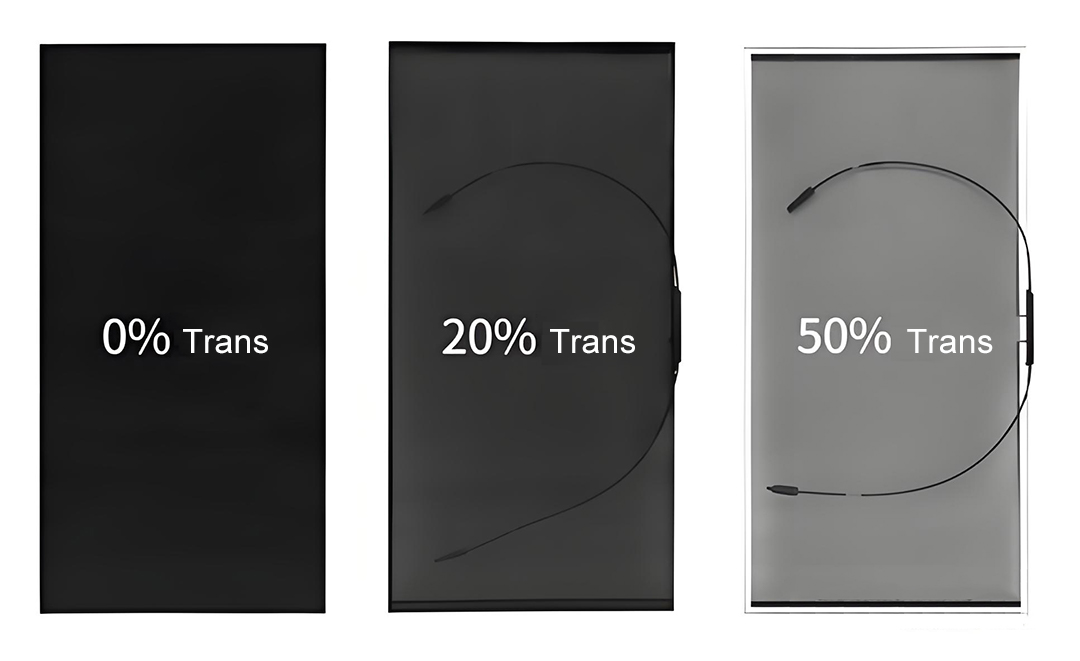
1.0 Light Transmittance CdTe Solar Glass
In applications where light transmittance
is not a requirement, such as rooftops of large centralized power stations,
industrial and commercial plants, inter-story and shear wall structures of
urban buildings, and distributed power station applications such as
photovoltaic storage and charging carports, opaque CdTe solar glass can be
selected. This type of solar-generating glass features low cost and high power
generation capacity, allowing more sunlight to directly reach the glass, improving
power generation efficiency.

2.20% Transmittance CdTe Solar Glass
For applications requiring both daylighting
and power generation, such as photovoltaic sunrooms, photovoltaic skylights,
and corridors, we can choose CdTe solar-generating glass with 20%
transmittance. This not only meets daily daylighting needs but also harnesses
solar energy for power generation, achieving the dual benefits of daylighting
and power generation.

3.50% Transmittance CdTe Solar Glass
For locations requiring higher visible
light transmittance, such as photovoltaic sunrooms and skylights, CdTe
solar-generating glass with 50% transmittance can be selected. It balances
light transmission, heat insulation, and power generation, effectively reducing
indoor heat loss and improving living comfort.

Furthermore, prices for CdTe solar glass
vary depending on its transmittance. Generally speaking, higher transmittance
translates to higher costs, so product selection should be tailored to your
budget.
3 Conclusion

As a new generation of green building
materials, CdTe solar glass has become a significant force in the green energy
sector due to its high photoelectric conversion rate, excellent light
transmittance, and wide range of applications. In practical applications, it's
crucial to scientifically and rationally select the appropriate product based
on your specific needs. As a practitioner, Zoom Solar Green Energy Technology
will continue to explore and innovate new application scenarios and technical
approaches to promote the sustainable development and progress of China's green
energy industry.